Industrial facilities operating in oil & gas, refineries, wastewater treatment plants, and petrochemical sites are often exposed to Hydrogen Sulfide (H₂S), one of the most dangerous gases for both human safety and electronic power systems.
At Hannibal Power & Technology, our industrial UPS and Rectifier systems are engineered to operate reliably in H₂S-contaminated environments with H₂S resistance, where standard power electronics rapidly degrade and fail.
Understanding the Risk of Hydrogen Sulfide H₂S
Hydrogen Sulfide H₂S is a colorless, highly toxic, and flammable gas produced both naturally and through industrial processes. While it has a characteristic rotten egg odor at very low concentrations, exposure to higher levels quickly numbs the sense of smell, making it undetectable and extremely dangerous.
From an engineering perspective, H₂S is a severe corrosive agent. It attacks copper and silver components, causing rapid degradation of electronic assemblies and leading to unexpected power system failures.

Why Standard UPS and Rectifier Systems Fail in H₂S Environments
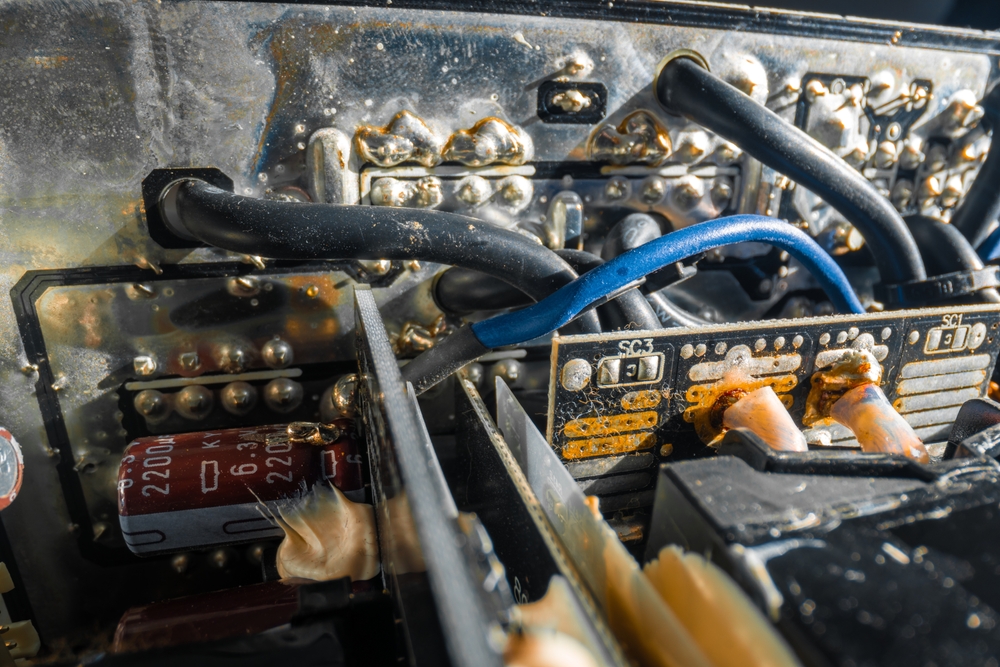
In the presence of H₂S, unprotected UPS and Rectifier systems suffer from sulfide corrosion, particularly on printed circuit boards (PCBs) and power modules.
- Formation of copper sulfide dendrites on PCB traces
- Increased leakage currents and internal short circuits
- Blackening and embrittlement of copper and silver conductors
- Premature system failure, often within weeks or months
For critical applications, this level of risk is unacceptable making H₂S resistant design mandatory.
Multi-Level H₂S Protection Design
Industrial UPS and Rectifier systems implement a three-layer protection strategy to ensure long-term reliability in corrosive atmospheres.
Level 1: Corrosion-Resistant Physical Enclosures
The first barrier is preventing H₂S from entering the system.
- NEMA 4X / IP66 rated enclosures
Dust-tight, water-tight, and designed for corrosive environments - 316L Stainless Steel or Fiberglass Reinforced Polyester (FRP)
Resistant to sulfur-induced corrosion and acidic condensation - Chemical-resistant gasketing
Closed-cell neoprene or silicone gaskets maintain sealing integrity over time
Level 2: Advanced Internal Electronics Protection
Because H₂S exposure can occur during maintenance or through cable entries, internal components are fully hardened.
- Conformal coating of PCBs
Acrylic, silicone, or polyurethane coatings create a protective barrier against moisture and H₂S Compliant with MIL-I-46058C and IPC-CC-830 - Gold-plated connectors and terminals
Prevent sulfide formation and ensure stable, low-resistance connections - Potted critical power modules
Key circuits such as IGBT drivers are encapsulated for complete atmospheric isolation
Level 3: Environmental Control & Gas Filtration (High-Power Systems)
For systems requiring forced ventilation due to high power density:
- Positive-pressure cabinet purging
The cabinet is pressurized with clean, filtered air. Because the pressure inside is higher than outside, H₂S cannot leak into the cabinet. - Chemical air scrubbers
Activated alumina filters impregnated with potassium permanganate (KMnO₄) neutralize H₂S before it reaches sensitive electronics

Designed for Critical Industrial Applications
Hannibal’s H₂S resistant UPS and Rectifier solutions are ideal for:
- Oil & gas production facilities
- Refineries and petrochemical plants
- Wastewater and sewage treatment stations
- Offshore platforms
- Pulp and paper mills
- Mining and heavy industrial sites
Reliable Power Where Failure Is Not an Option
In H₂S rich environments, standard commercial power systems are not enough. Long-term reliability requires purpose-built engineering, material selection, and environmental protection.
With Hannibal Power & Technology, you get industrial UPS and rectifier systems designed to withstand corrosive atmospheres, ensure uninterrupted power, and protect mission-critical operations.
Contact Hannibal today to learn more about our H₂S-resistant power solutions for harsh industrial environments.





 Reach us on WhatsApp